You get home from a weekend at the beach, hose the car down in the driveway, and it looks fine. The paint is clean. The wheels are clean. Everything you can see is sorted.
The problem is everything you cannot see. An underbody car wash deals with the half of your vehicle that never gets touched by a driveway hose or a standard exterior wash, and on the Queensland coast that half takes the most punishment. Salt and sand work their way into the wheel arches, sit along the chassis rails, and pack into gaps around the suspension where they stay damp for days.
This post covers what an underbody wash actually reaches, why salt does more damage than mud, how to do it yourself in a self-serve bay, and how often it is worth bothering with. If you tow, drive on sand, or just park somewhere near the water, it is worth ten minutes of reading.
What an underbody car wash actually reaches
A normal wash, whether it is a tunnel, a bay or a bucket in the driveway, works on surfaces you can see and reach. Water runs down and off. Nothing pushes it upward.
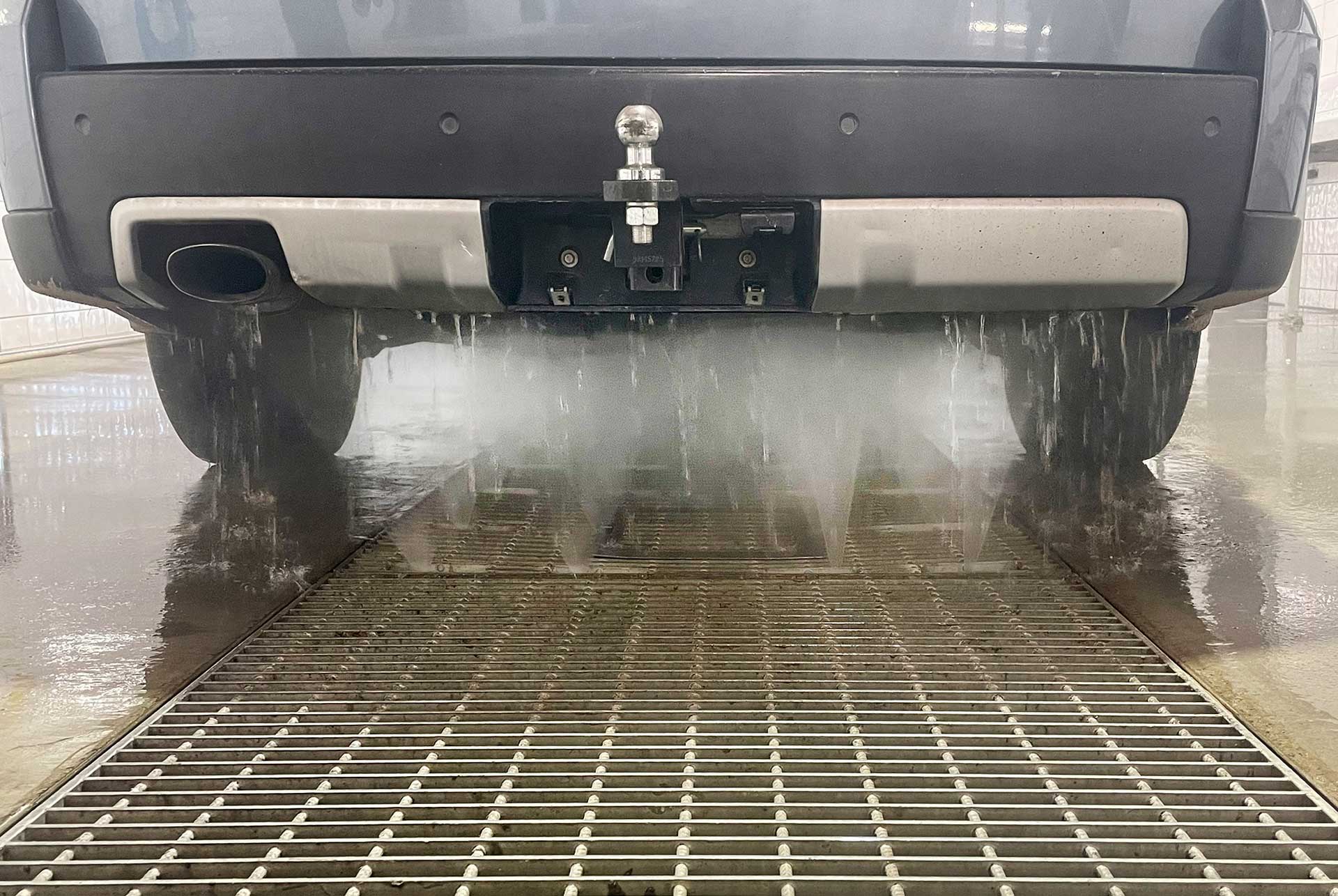
An underbody wash does the opposite. High pressure jets sit low in the bay or in the tunnel floor and spray up into the underside of the vehicle as it passes over or sits above them. That gets water into the places that hold contamination the longest:
- Chassis rails and cross members
- The inside of the wheel arches, above and behind the tyre
- Suspension components, springs and mounting points
- Exhaust and heat shielding
- Subframes and any factory or aftermarket underbody protection
- The lip and inner face of the rear bumper, where road spray collects
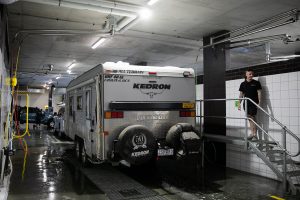
On our self-serve bays, the underbody option runs through fixed jet locations in the floor rather than the wand you hold. Bay 4 has two jet locations and is set up for normal sized vehicles, and Bay 2 has four and is set up for larger vehicles, trailers, caravans and trucks. You drive over them and the jets do the reaching, which is the part you cannot replicate by lying on the ground with a hose.
Salt is worse than mud, and coastal air counts
Mud is mostly an appearance and weight issue. It dries, it flakes off, and where it stays wet it holds moisture against metal, which is not great, but it is a slow problem.
Salt behaves differently. It draws and holds moisture, and it keeps working on bare or chipped metal long after the surface looks dry. That is why a vehicle that has been on sand can look perfectly clean on the outside and still be carrying a corrosive film underneath. Rinsing the paint does nothing about it.
Two things surprise people. The first is that you do not need to drive on the beach to pick up salt. Parking near the water is enough, because salt carries in coastal air and settles on whatever is there, including the underside of a car that has never left the bitumen. The second is that fresh water is the fix. There is no special chemistry required for the bulk of it. Salt is water soluble, so the job is volume and pressure directed at the right places, promptly.
Promptly is the part that matters most. A wash the day you get back does more good than a better wash a fortnight later.
How to do it yourself in a self-serve bay
The bays are charged by the minute, so a bit of order saves you money.
- Rinse the loose material off first. Use high pressure rinse on the body, wheels and arches before you start on the underside. Sand that is sitting on paint will scratch it if you start scrubbing or foaming over the top of it.
- Do the wheels and arches. Wheel and tyre cleaner, then high pressure rinse. Get the wand up inside the arch, front and back of the tyre. This is where most of the sand is.
- Then run the underbody jets. Position the vehicle over the jet locations and let them run. Move the vehicle forward or back partway through so the spray hits from more than one angle.
- Wash the body. Powerfoam or high pressure soap, then the foam brush if you want it, then high pressure rinse.
- Finish with spot free rinse. Last step, top down. Do not skip it if you are washing in the sun.
Two things worth knowing. Door jambs, the boot opening and the fuel filler surround collect salty residue and are easy to miss, so open them up and rinse them. And if your vehicle has a canvas cover, a pop top or anything similar, keep high pressure away from the seams.
Self-serve bay, tunnel upgrade or booked hoist wash
There are three ways to get this done and they suit different situations.
Self-serve bay. You control how long you spend and where the pressure goes, and you can go over the same area twice if it needs it. Bay 4 runs at $4 per minute and Bay 2 at $6 per minute. Best option after a beach or off-road trip, because that is when you want to be thorough rather than fast.
As part of an automatic wash. Our Express Tunnel has a Double Underbody Wash upgrade for $15. On the Combi, an underbody wash is already included in the Platinum Combi, Soft Cloth Premium and Touch Free packages, and there is a $5 underbody wash upgrade otherwise. The 24 hour Tradie Wash has a $5 underbody wash add-on and a $5 underbody blow dry, though the blow dry is not recommended for open tray utes. This is the right choice for routine upkeep.
A booked hoist wash. Some Brisbane workshops will put the vehicle on a hoist and go over the underside by hand, usually as part of a rustproofing service. It is thorough and it costs accordingly, and you need an appointment. Sensible before you apply rustproofing or if you are buying or selling. Overkill as a regular habit.
How often is worth it
There is no single answer, so use the trigger rather than the calendar.
- After any beach or sand driving: every time, as soon as you can.
- After towing on unsealed roads: every time.
- If you park within sight of the water: work it into your regular wash.
- Everyday suburban driving, nowhere near the coast: occasionally is fine.
If you are washing often enough that you are thinking about the cost, the Unlimited Wash Club is worth a look. There is no locked in contract and fleet options are available, so it suits people who are washing weekly rather than monthly.
Frequently Asked Questions
What is an underbody car wash?
It is a wash that directs high pressure water upward into the underside of your vehicle, rather than down onto the paint. Fixed jets in the floor of a bay or tunnel spray the chassis, wheel arches, suspension and exhaust area. These are the parts a normal exterior wash cannot reach, and they hold dirt and salt the longest.
Is an underbody wash worth it?
If you drive on sand, tow on unsealed roads, or park near the coast, yes. Salt holds moisture against metal and keeps working long after the vehicle looks clean, and no amount of washing the paint removes it. If you only ever drive on suburban bitumen well away from the water, it matters less and you can do it occasionally.
How do I wash the underbody of a 4WD?
Use a bay with fixed underbody jets and enough clearance for the vehicle. Rinse the loose sand off the body and arches first so you are not grinding it into paint, get the wand up inside the wheel arches, then run the underbody jets and reposition the vehicle partway through so the spray reaches from more than one angle.
How soon after the beach should I wash my car?
The same day if you can manage it, or the next. Salt keeps drawing moisture for as long as it is sitting there, so a quick wash straight away does more for the vehicle than a thorough one a couple of weeks later. If you cannot get to a bay, a driveway rinse of the arches is better than nothing until you can.
Can an underbody wash damage anything?
Not on a standard vehicle. The pressure is set for the job. Be more careful if you have aftermarket underbody work, exposed wiring, or a vehicle with existing rust, because high pressure can lift material that is already loose. Keep pressure away from canvas seams and pop top skirts, and skip the underbody blow dry on an open tray ute.
Get the salt off before it settles in
An underbody car wash is not the part of car care anyone looks forward to, but it is the one that decides how your vehicle looks and holds together in five years rather than five days. Salt and sand do their damage quietly, in places you never see, and the fix is simple: fresh water, decent pressure, pointed in the right direction, soon after the trip.
If you have just come back from the sand, our self-serve bays at Brendale let you take your time over it, with Bay 2 set up for anything larger you are towing. If you would rather it happened automatically every time you wash, the underbody options on the Combi and Tunnel handle it without you getting out of the car.
And if you are washing often, the Unlimited Wash Club makes more sense than paying per visit. No locked in contract, and you can join online in a couple of minutes.
Find us at 23 Doherty Street, Brendale. See our location and hours.