Most articles comparing a touchless car wash to a soft-touch one are written by a business that only owns one of the two machines. The conclusion is usually easy to guess from the first paragraph.
We run both at Brendale, at the same price, so we have no reason to talk you out of either. The honest answer is that neither one wins outright. They fail in different ways, and which one suits you depends on your paint, your car and how dirty it is when you arrive.
This post covers what each system actually does, the real risk attached to each, where touchless falls short, and how to pick between them on any given day.
What each one actually does
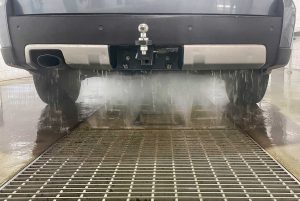
A touchless wash, also called touch-free or brushless, cleans using high pressure water and detergent. Nothing physically contacts the paint. The chemistry does the work of breaking down road film, then pressure rinses it away.
A soft-touch wash uses soft cloth or foam strips that make contact with the surface, moving over the panels with plenty of lubrication from the soap. That physical contact is what lifts dirt the water pressure alone will not shift.
Everything else about the two is largely the same: pre-soak, wheel cleaning, rinse, protectant, dry.
The honest paint risk of each
Soft-touch risk: contact. Anything touching your paint can, in the wrong conditions, leave fine marring or swirl marks. The risk is not the cloth itself. It is grit that was on the car when the cloth passed over it, or a machine whose materials have not been maintained. Modern closed-cell foam and well-maintained cloth on a properly lubricated car is a long way from the spinning nylon brushes people remember from decades ago, but the risk is not zero.
Touchless risk: chemistry. With no contact doing the work, touchless systems rely on stronger detergents, often more alkaline. Used repeatedly as your only wash method, that can shorten the life of a wax or sealant layer. It will not damage the clear coat itself, but a car stripped of its protection is more exposed to bird droppings, tree sap and water spotting, which do etch.
So the trade-off is contact against chemistry, not safe against unsafe.
Where touchless falls short
Touchless struggles with anything bonded to the surface rather than sitting on it.
Dried-on bugs across the front bar after a run up the Bruce. Tree sap. Heavy clay-based mud after an off-road weekend. Brake dust baked onto wheels. In those cases a touchless pass will often get the car most of the way there and leave the stubborn patches behind.
Soft-touch handles all of that better, because friction is simply more effective on bonded contamination than pressure is.
Which to choose for your car
Choose touchless if:
- Your car is ceramic coated, freshly painted or wrapped
- You have a dark colour where swirl marks show up in direct sun
- You drive something with delicate trim, decals or a matte finish
- Your car is only moderately dirty and you wash regularly
Choose soft-touch if:
- The car is genuinely filthy rather than dusty
- You have bugs, sap or dried mud to shift
- You have gone longer than usual between washes
- You want the most thorough single-pass clean available
A useful habit for a coated or dark car is to use touchless as the default and bring in a soft-touch wash occasionally when the car needs more than pressure can deliver. For most everyday drivers, alternating is perfectly sensible.
Whichever you use, an underbody wash matters more than either question if you have been near saltwater.
Both at one site, same price
At Brendale both options sit in the Combi Autowash, and both cost the same.
Touch Free, $27.95. Underbody wash, high pressure wheel spray, pre-soak, high pressure clean, clear coat protectant, spot free rinse and a double dry.
Soft Cloth Premium, $27.95. Underbody wash, wheel scrub, high pressure wheel spray, high pressure clean, softwash and shampoo, clear coat protectant, spot free rinse and a double dry.
If you want the most complete version, Platinum Combi at $32.95 adds pre-soak, extreme shine wax and the full wheel treatment on top.
There is also a 24 Hour Tradie Wash at $27.95, available between 5pm and 7:30am, for work vehicles that need cleaning outside business hours.
For a quicker drive-through option, the Express Tunnel runs from $27.95 to $37.95 depending on the package. Full details of both are on the Combi Autowash section of our services page.
Because you can switch between them at no extra cost, the choice stops being a commitment and becomes a decision you make based on how dirty the car is that day. That is also the argument for the Unlimited Wash Club. Washing more often, with less dwell time for contaminants, does more for your paint than agonising over which machine to use. We ran the numbers on that in our post on what an unlimited membership actually saves you.
Frequently Asked Questions
Is a touchless car wash better for your paint?
It carries no risk of contact marring, which makes it the safer choice for ceramic coatings, dark paint, wraps and new finishes. The trade-off is stronger detergents that can wear down wax or sealant over time if touchless is the only wash you ever use. Neither option damages clear coat in normal use.
Do touchless car washes actually get your car clean?
For everyday road film, dust and light grime, yes. Where they fall short is bonded contamination like dried bugs, tree sap, baked-on brake dust and heavy clay mud, which usually need physical contact to lift. If your car is in that state, a soft-touch wash will give you a better result.
Do soft-touch car washes scratch your car?
Modern soft cloth and closed-cell foam, kept clean and used with plenty of lubricating soap, carries a low risk. Most marring traced to automatic washes comes from grit already on the vehicle or from poorly maintained equipment rather than the material itself. The risk is small but not zero.
Which is better for a ceramic coated car?
Touchless is generally the better default, since the coating is doing the protective work and you avoid any contact with the surface. Many coated cars do well on touchless most of the time, with an occasional soft-touch wash when a deeper clean is needed.
What is a brushless car wash?
Brushless, touch-free and touchless all describe the same thing: a wash that cleans with high pressure water and detergent, with nothing making contact with the paint. The term exists mainly to separate these systems from the old spinning-brush machines that gave automatic washing a bad name.
Pick the wash that suits the day
The comparison is not gentle versus harsh. It is contact versus chemistry, and each one handles a different kind of dirt better.
If your car is coated, dark or new, lean touchless. If it is covered in bugs, sap or mud, soft-touch will do a better job in a single pass. Most drivers are best served using both, depending on the week.
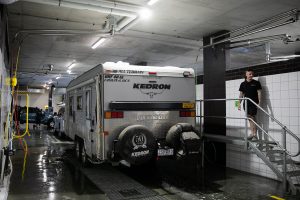
Both options are available at 23 Doherty Street, Brendale, at the same price, so switching costs you nothing. If you are washing more than once a month, the Unlimited Wash Club is worth a look, with no locked-in contract and caravans included.